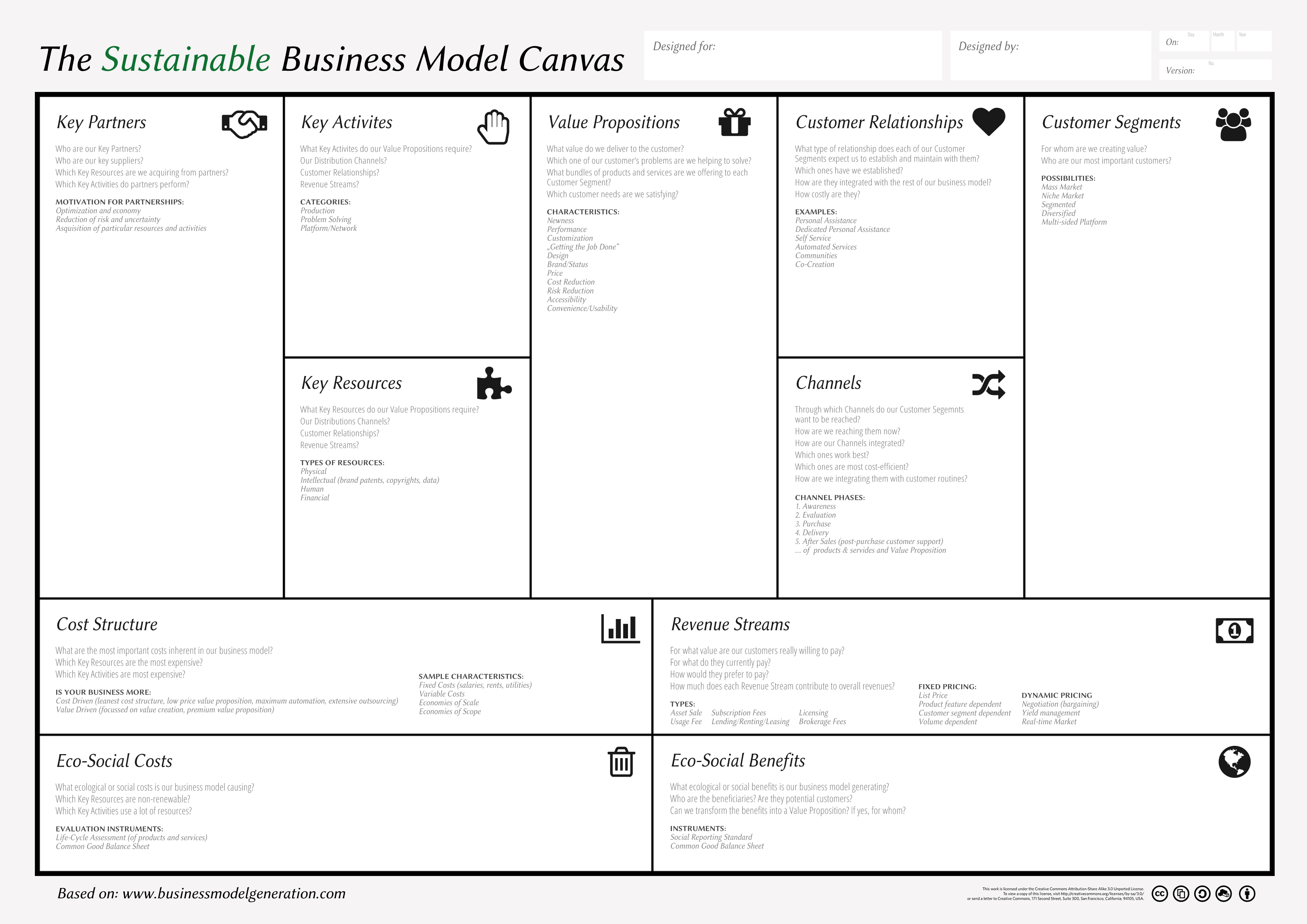
Sustainable Business Model Canvas

  • Why you should analyse environmental sustainability of the business model upfront – and how

    Would you start a business without making a business case? – or at least have a very good idea of the business model you are pursuing? – I wouldn’t! Here we look at the potential of using the Business Model Canvas for assessing the environmental sustainability of business ideas.

    Today the Business Model Canvas has received quite some traction and is being used in many settings for getting a shared picture of a business concept or to discuss new approaches to the business model.

    It is broadly recognised that new businesses should be “sustainable businesses”. Yet, it is very few teams that do an upfront assessment of the environmental sustainability prior to starting their endeavour. Some companies do a Life Cycle Assessment of a key product or product range. However, these evaluations are typically performed after the decision of moving ahead and a production is going on. Usually the findings will not impact the business model fundamentally, but lead to tweaks of a few parameters along the way.

    Why you should analyse environmental sustainability of the business model upfront – and how /from BioCircular.eu
    Why you should analyse environmental sustainability of the business model upfront – and how /from BioCircular.eu

    Some of the ”progressive” financial investors have implemented a due diligence process in order to scrutinize the environmental and social impacts of a company before an investment is decided. However, this process is not challenging the business model, but is focusing on minimizing the impact on the environment in the production (emissions, energy consumption, etc.) or ensuring the health and safety of workers.

    I am convinced that novel and much more sustainable (also economically) businesses would emerge, if the environmental implications of a business idea were to be taken into account in the planning phase.

    What-if you actually considered the environmental sustainability up front and made it an integral part of choosing the right business model?

    Sustainability works as a constraint that inspire us to seek creative solutions and can thus be a key driver of innovations. Innovating not only products or services, but also entire business models to create new ways of delivering and capturing value. This can serve as a new basis of competition altogether!

    Some ideas would have benefitted from thinking environmental sustainable into the product or service from the start. E.g. the idea of adding micro-plastic beads to cosmetics or toothpaste, that enters the environment when you flush it into the sink. Or, would you design a new e-currency with a distributed accounting system, that requires an enormous amount of energy to run, exceeding that of countries? And that is even before the system has really taken off as a transactional currency, but still is more of an investment in itself.

    Where to start if you are not familiar with environmental issues?

    In general, the Business Model Canvas (BMC) provides an intuitive framework for developing a business model. It does not take long to grasp the concept and start playing around with the building blocks. If you are a small team, filling in the canvas provides a useful shared picture for discussing ideas. To dig deeper in your analysis or discussion of aspects, you would probably supplement the Business Model Canvas with other tools, such as SWOT or PESTEL understand your business proposition in a business context.

    Now is the time for the next steps…

    Environmental sustainability tools are still an emerging field, and there is not yet established methods out there to use. Nevertheless, there are some. If you are familiar with the Business Model Canvas – why not try some of the tools that work as add-ons to this? Below I will suggest a few that you could start with.

    These tools help you address other bottom lines than the economic; the environmental and the social. It is adding to the complexity of developing the right business model, especially as the costs and benefits are measured in various other metrics than money.  Therefore, the tricky part comes when you need to balance the trade-offs and select the business model to pursue.

    When you work with the Business Model Canvas, you should go through iterative loops of increased knowledge before you home in on the business model of your choice. As you refine your concept, you need to utilise other tools. Traditionally you would use Porter’s five forces, 4Ps, etc. to analyse various economic aspects. The method is the same here, but you will need additional tools for exploring the environmental aspects of your options.

    The Triple Layer Business Model Canvas (TLBMC) is developed to be a practical tool for developing, visualizing, and communicating sustainable business model innovations. It consists of three canvases. The standard Business Model Canvas for economics, and two additional layers, one for environmental aspects, and the second for social. As with the standard Business Model Canvas, you can begin your exercise using an existing business as a starting point and from there explore possible innovations to the existing model and the potential impact of such innovations. The downside of the TLBMC is that the environmental layer is based on lifecycle assessment thinking and data. Thus, it relies on numbers, which you need to have access to or lookup in order to provide a convincing foundation. You can use it without numbers, but then the TLBMC tool provides no guidance as to how and what to consider.

    The Sustainable Business Model Canvas developed by Threebility provides additional cells to the standard Business Model Canvas with guiding questions that make you consider some sustainability aspects. In addition to the extension of the original Business Model Canvas you can find supporting tools that allow you to consider different sustainability aspects of your business in more detail, e.g. the Sustainability Impact Canvas, a Product Ethics Canvas, Sustainability SWOT, and a balanced score card. It is a fine package; however, the tools do not have environmental sustainability in focus, and thus miss out considering environmental aspects in more detail. A key challenge with these tools (as in most sustainability frameworks) is that it is difficult to prioritize or rank the pros and cons that you elucidate through your efforts.

    The Flourishing Business Canvas expands the 9 building blocks of the original Business Model Canvas to 16 questions that has a wider perspective on the organisation rephrasing the canvas and embedding it into the societal and environmental scene. The concept seems appealing but it is currently not easy to use as the ‘Flourishing Enterprise Innovation Toolkit’ allowing you to further elaborate on the questions is behind a pay-wall.

    Other efforts

    Several other organisations, projects and initiatives have developed modified Business Model Canvas templates to include sustainability aspects, often adding extra boxes within the canvas. However, even though these indicate that in order to build a sustainable business, you need to consider other elements, I fail to see that they truly assist your thinking to create environmental sustainable businesses.

    alternative Business Model Canvas templates adding sustainability aspects into the overview. Found at https://rethinkbusiness.dk/ and https://www.case-ka.eu/wp/wp-content/uploads/2017/05/SustainableBusinessModelCanvas_highresolution.jp
    Alternative Business Model Canvas templates adding sustainability aspects into the overview

    Two alternative versions: The Sustainable Business Model Canvas with two extra blocks below. and The Sustainable Business Model Canvas with an additional block under distribution.

    Conclusion: How to proceed adding environmental sustainability considerations in your business model development?

    The above mentioned extensions to the Business Model Canvas may serve as tools to help users conceptualize, understand, and communicate the impact of a business model and thus assist in developing new and exciting sustainability-oriented innovative businesses.

    However, only a couple of them really challenges your systems thinking, so that you truly consider environmental aspects in designing new business models. Among the extensions mentioned in this blog post, I would recommend giving the Triple Layer Business Model Canvas a go. It seem to be the best rooted approach, but may require some preparation in order to dig out data from a Life Cycle Assessment database or at least have established an overarching idea of the impact in different parts of a product life cycle and not only impacts within your business activity. In your efforts you could add e.g. the Sustainability Impact Canvas or balanced score card tool from Threebility.

    I would of course also encourage you to learn more about the environmental elements that you should consider in developing a sustainable business, e.g. ecosystem services, systems thinking, Life Cycle thinking, Nature-based Solutions, cradle-to-cradle, bioeconomy principles, and circular economy principles.
    – Concepts in which we at BioCircular.eu could offer some 101 for you to get a general idea about.

    Good luck!

    (Should you know of other add-ons, extensions or other relevant tools to supplement the original Business Model Canvas, then please do not hesitate to contact us)

  • Nature-based Solutions – a possible path to business

    In recent years, businesses increasingly recognise that they rely on nature for ecosystem services that underpin their activities or would put them at risk if disappearing. Perhaps Nature-based Solutions could be a tool for developing future – truly sustainable – businesses? This text explores some of these opportunities. But first, what is Nature-based Solutions?

    Working in the bioeconomy arena, I have been hearing about Nature-based Solutions for some years. Especially in the context of arriving at ”green solutions”, that are focused on developing climate smart solutions. However, it was only recently that I realized that, ‘Nature-based solutions’ is not just another way of saying ‘bio-based’ as opposed to ‘fossil-based’. ‘Nature-based Solutions’ is actually a concept that has been coined within fairly recently. Since around 2015 researchers, have pondered on how to actually define it, and operationalise it. The International Union for Conservation of Nature (IUCN), has made a great body of work and in the summer of 2020 published a global standard for Nature-based Solutions (which they abbreviate NbS). The ambition is that the standard can serve as a tool to design, verify, and upscale NbS.

    There is not yet complete consensus about what Nature-Based solutions actually is. However, all revolve around the same overarching ideas. IUCN define Nature-based Solutions as:

    “actions to protect, sustainably manage, and restore natural or modified ecosystems, that address societal challenges effectively and adaptively, simultaneously providing human well-being and biodiversity benefits”

    Illustration from IUCN showing what Nature-based Solutions entail.

    The European Commission has pushed for Nature-Based Solutions (abbreviated NBS) for some years, and with the biodiversity strategy from 2020, the Green Deal and Horizon Europe (the research and innovation Framework 2021-2027), the European Commission envision NBS to play a major role in the societal transition in Europe. They define Nature-Based Solutions as:

    Inspired and supported by nature, which are cost-effective, simultaneously provide environmental, social and economic benefits and help build resilience. Such solutions bring more, and more diverse, nature and natural features and processes into cities, landscapes, and seascapes, through locally adapted, resource-efficient and systemic interventions. – Hence, nature-based solutions must benefit biodiversity and support the delivery of a range of ecosystem services.

    As I understand it, both definitions say that nature-based solutions deliver benefits for both nature and society within a solution. Thus, nature-based solutions are not an off-set strategy but are actions that on one side provide tangible and measurable benefits for biodiversity and/or ecosystems and on the other provide some benefits to humans.

    The differences in the definitions are somehow reflecting divergent views on the balance between the benefits. Should the nature-based solutions focus primarily on benefits for people, society or businesses or should they focus on contributions to halt biodiversity loss, ecosystem restoration and integrity?

    It can be viewed as a spectrum, and solutions at the endpoints provide benefits either to nature or to society and is solely “do no harm” to the other. Depending on the definition, the span to the right-hand side considered nature-based solutions, will vary.

    Nature-based solutions should be integrated solutions providing benefits for both biodiversity/ecosystems and society. How much a solution benefit either of the two, is key in determining if a solutions is actually a nature-based solution. (own graphic)

    Examples of Nature-based solutions

    In the European Union the European Commission engaged experts to conduct an analysis of nature-based solutions that had been implemented as part of EU funded projects.  

    These examples include renaturing landfill sites, restoration of catchments and coastal landscapes, making green roofs and walls in urban areas, increase cycle and pedestrian green routes, using tree planting in cities for shade, cooling and relaxation. Other examples from various organisations often include focus on the climate mitigation effects as well as restoration.

    The colour is green – but what is the benefit for biodiversity or the ecosystems?
    – A green solution is not always a nature-based solution.

    Why a green solution is not necessarily also a nature-based solution

    Case: The case of green roofs – it might and it might not be a true nature-based solution

    A group of trees, a field of grass, or other nice and green looking areas seem to be obvious cases of nature-based solutions.

    However, just because the result looks green, it does not make it a nature-based solution by default!

    In a research paper (Eggermont et al, 2015) the researchers provide an example:

    Green roofs and other green surfaces in urban areas might have positive climate impact but if the green roof or wall is covered by only very few species of plants, that doesn’t belong to the area, then it is very limited, how much the area is contributing to the local biodiversity. E.g. if insects are not able to feed on the plants or get nectar from the flowers. Introduced plant species might also spread uncontrolled to adjacent parks or other green areas and thus outcompete the natural flora. If the seeds were all coming from only a few strains then the genetic diversity is low, and the plants might have low tolerance to drought or diseases. Should an event hit the area, they all suffer.

    Thus on city level, the variety across rooftops becomes important to ensure the resilience and diversity in the implemented solution and thus the benefit for nature.

    Case: re-forestation looks green, but may not be a true nature-based solution

    Reforestation initiatives have been established as a climate change mitigation effort, that capture carbon and also provide biomass for bioenergy. However, Center for International Forestry Research (CIFOR) sees the decades-long afforestation policy in Chile running from 1974 to 2012 as a case of a poorly designed tree-planting initiative. It has resulted in widespread tree plantations for valuable commodities and replaced native forests, causing a loss of biodiversity and natural carbon sinks. So, the new forests may look green, and they do capture CO2, but they are not providing additional benefits for nature.

    How can nature-based solutions be a business?

    Perspectives for businesses
    Many businesses depend on ecosystem services in their activities, either directly or through inputs that depend on ecosystems. Also, many businesses have impacts on nature through e.g. emissions, water, energy, land-use or waste-streams.

    A large variety of ecosystem services can be enhanced by Nature-based Solutions. And I believe there is still much to gain by using the NBS framework for developing new solutions, not only for the benefit of society, but also for businesses. NBS business model is still in its infancy and examples need to be showcased. There are challenges in developing a NBS business, some of which are pointed at below.

    Business challenge: The benefits of Ecosystem services and biodiversity are often free
    You are right in thinking, that it can be a challenge to come up with NBS concepts that would be a economic viable business in itself. And there are several reasons, one of which is that ecosystem  services are often seen as externalities and usually not paid for. This means that you do not pay to utilize ecosystem services in your business. E.g. the apple plantation does not pay for the bees to pollinate the apple-blossom (at least not in Europe). So, a plantation owner would often forget about this benefit. On the other hand, if the owners are aware that this is a key ecosystem service on which the business rely, they might want to minimize risk by e.g. ensuring a nice variety of flowers among the apple trees that keep the insects happy their entire growth season and lifecycle.

    Guaranteeing pollinating insects are around helps the plantation, but it might also benefit the neighbouring farmers or plantations. Even though they benefit, it is difficult to sell the service to them, or have them pay a share of the cost. 

    As biodiversity and ecosystem services often are unpaid benefits, and often not restricted to a smaller area with a single owner, it makes it difficult to realise the business case. However, as for the case of green roofing, going from a roof to a city of level perspective opens up for selling a range of plants or grouped into ‘mini-habitats’ that can benefit various organisms.

    Businesses providing nature-based solutions in the making

    Here is what I would consider an example of a nature-based business:

    Case: Production of mussels for clean water

    Along the Danish coasts there is a lot of nutrients in the water. Partly due to the run-off of fertilizer from farmland. A concept has been developed to farm mussels in these waters. Not with the purpose of producing mussels for meals but as a way of removing nutrients from the water, as a ‘cleaning service’. If the purpose is removal of as much biomass as possible, then the producer will not ensure the mussels have ample of space to develop into a large fleshy size, and thus remove growth from the lines during the growing period, etc. It is still experimental, and not yet a viable business.

    production of mussels can enhance a coastal ecosystem, remove nutrients from the water and provide food feed
    Production of mussels can enhance a coastal ecosystem, remove nutrients from the water as well as providing food and feed.

    The largest of the mussels can be harvested for food, but there is still no valuable products to be made from the rest of the mussels of odd sizes. However, if the agriculture farmers had to pay a fee for the nutrient removal it would be economically feasible and thus be a perfect example of a NBS business. The mussels filters microalgae out of the water, the microalgae thrive with the high nutrient load. Removing the microalgae makes the water clearer. This improves the conditions for bottom living algae and plants and improves the oxygen levels in the water. All of which also benefit fish and other animals in the coastal zone. The production is taking place in rural/coastal areas and would benefit the local employment and local economy.

    The transition into a bio-based future will probably lead to good ideas for how to use the shells and meat of the smaller mussels, and I predict that we will see this type of mussel farming in the future.

    Other ecosystem services or resources could become a business

    Fresh water is increasingly a scarce resource. However, rainwater is often seen as a problem and is expensive to pipe out of urban areas. Thus new businesses might probably emerge that can utilise rainwater to ensure clean water for business activities, drinking, bathing etc., within city boundaries as well as securing clean water flowing into natural systems.

    With a little creativity, I am sure other new innovative businesses can be develop that not only “do-no-harm” to nature, but actually is economically profitable, benefit people while also improving the situation for nature.